Healthcare Leader’s Guide to Digital Tools: How to Choose Solutions That Reduce Clinician Burnout
Table of Contents
Digital tools and technology innovation have been part of U S healthcare for decades, and the progress so far has been impressive. In 2025 alone, billions were invested in digital health, and with the rise of AI, the space is gaining traction at a rapid pace. This push often leaves healthcare leaders feeling pressured to adopt new solutions or risk falling behind.
Yet even with all this momentum, organizations still face a crucial choice. Will these tools genuinely support clinicians and patients, or will they pull the system into another hype cycle?
The real task is to separate solutions that deliver measurable value from those that add more complexity to daily work. This piece aims to offer clarity on how leaders can make these decisions with confidence.
Digital Tools: From Experiment to Everyday Infrastructure
Digital tools in U S healthcare have evolved from experimental IT projects in the 1960s to an indispensable, mission-critical infrastructure by 2025. This shift was not accidental. It was driven by policy, especially the HITECH Act and meaningful use incentives that pushed electronic health records (EHR) and interoperability from niche concepts to the foundation of clinical operations.
Today, every hospital and clinic depends on a tightly connected digital stack that includes enterprise EHR systems, computerized provider order entry, mandatory e-prescribing, integrated revenue cycle platforms, patient portals, and embedded telehealth. This structure reaches far beyond billing or regulatory needs. It guides the entire care journey, shapes team communication, and supports compliance.
Yet even with this progress, the digital environment remains complex and often difficult for clinicians to manage day after day. The key question in 2025 is whether these tools genuinely improve productivity and patient care or if the system has unintentionally created new layers of inefficiency and burnout. The answer will influence how healthcare evolves from here.
The Reality: Why Some Digital Tools Flourish While Others Fail
Building on the past trajectory of digital healthcare, we gain important insight into which tools have truly supported clinicians and which have struggled or disappeared.
Research from recent years shows that only a select group of digital tools endure, and their success is rarely about software sophistication or FDA clearance alone. The tools that make a lasting impact are the ones built directly into clinical and financial workflows. Those that sit on the outside, regardless of how promising they appear, often fall short because they lack the fundamentals required to support day-to-day care.
Failure Patterns Backed by Evidence
- Early prescription digital therapeutics. Pear Therapeutics, one of the most recognized names in the space, filed for bankruptcy in 2023 despite FDA-cleared products. Thin reimbursement, high operating costs, workflow misalignment, and limited real-world results proved unsustainable.
- Overcrowded mental health and wellness apps come next. Engagement dropped quickly for many consumer-facing apps. Studies point to weak evidence of benefit, privacy concerns, and inconsistent reimbursement as major barriers.
- Fragmented or standalone digital tools. Dashboards, RPM tools, and AI decision-support platforms that fail to integrate with EHRs remain isolated. Without seamless workflow placement, these tools rarely scale.
The Sidecar Zone: Today’s “Optional” Tools and Tomorrow’s Essential Infrastructure
Not all digital solutions need universal adoption to matter. In 2025, several sidecar tools are quickly shifting from small pilot programs to essential components of modern care.
Remote patient monitoring programs continue to show meaningful results. Large studies report average reductions in hospitalizations of 9-10%, with some programs cutting 30-day readmissions for heart failure and COPD by up to 50%.
AI scribes and ambient documentation tools are reducing documentation time by 10% or more in many implementations. These gains return tens of thousands of work hours to clinicians and help reduce after-hours charting.
Predictive analytics and digital front doors are becoming central to scheduling, messaging, payments, and navigation. For patients and staff, unified access is quickly becoming a necessity for smooth operations.
How to Move from Paradox to Productivity: The Litmus Test for Digital Health Tools
A clear pattern is emerging across high-performing systems. Success now depends on whether a digital tool can be measured, integrated, and show a net positive impact on clinician time and patient outcomes.
Digital Tools That Last
- Demonstrate a quantifiable reduction in clinician time spent per patient or per day (e.g., note time down by ≥10%; 15,000 hours saved in large AI scribe implementations).
- Lower acute care utilization (RPM reducing avoidable hospitalizations by 9–10% on average).
- Are reimbursement-ready: Backed by payers, embedded in billing, and able to show return on investment for both value-based and fee-for-service models.
Digital Tools That Stall or Fail:
- Exist outside the clinician workflow, requiring separate logins, adding to click burden, or creating data silos.
- Have inadequate long-term engagement (e.g., mental health apps with >50% drop-off after only a few uses).
- Lack evidence beyond regulatory approval, especially real-world outcomes that matter to payers and frontline teams.
Decision-makers should ruthlessly apply this “productivity litmus test” before launching or scaling any digital tool: Does it measurably free up time, prevent unnecessary hospital use, and fit within core workflows? If not, expect a limited shelf life.
Forward Looking Leadership: What Will Matter Most by 2030
The biggest opportunities for the next five years will come from tools that transform care from “more digital” to “net-positive workflows for clinicians and patients.”
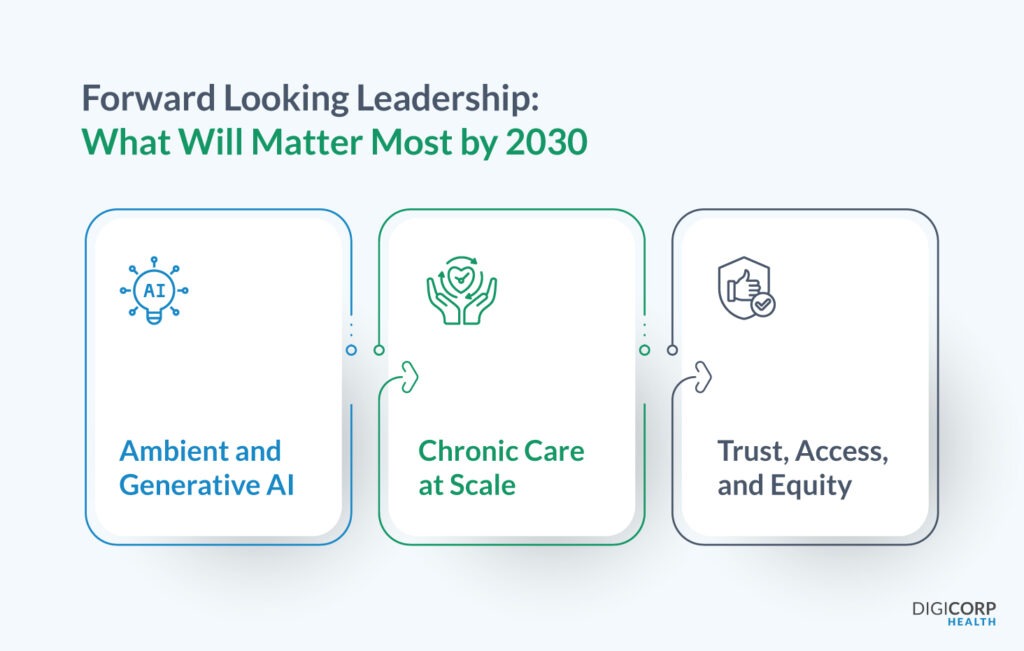
- Ambient and Generative AI: By 2030, ambient intelligence (AI scribes, smart checklists) will not just drive reductions in click burden; they are projected to automate 15% of healthcare work hours, a productivity swing equivalent to hundreds of FTEs per major health system.
- Chronic Care at Scale: RPM and telehealth, integrated with predictive analytics, will likely become the new infrastructure for value-based care, improving outcomes and closing costly care gaps.
- Trust, Access, and Equity: As new tools arise, leaders must validate that technology narrows disparities, meets privacy standards, and addresses the “last mile” of digital literacy.
Conclusion: The Path to Meaningful Results in Digital Health
U.S. healthcare’s productivity paradox will not be resolved by more technology, but by smarter, deeply integrated solutions that are evaluated through the lens of time returned to clinicians, unnecessary admissions prevented, and equitable access to quality care. Only those tools that deliver measurable, workflow-embedded value will survive, and truly help clinicians and patients thrive in the years ahead.
Decision-makers should ensure every digital investment passes the litmus test: measurable, integrated, reimbursable, and sustainable. Or risk repeating the paradox for another decade.
If your aim is to bring in digital tools that reduce workload, support clinicians, and improve patient outcomes, Digicorp can help. Our team partners with healthcare leaders to build solutions that fit real workflows and deliver measurable results.
Schedule A Call Now
Sanket Patel
- Posted on December 15, 2025
Table of Contents