Healthtech for Marginalised Communities: How Leaders Can Close Care Gaps
Table of Contents
Healthcare is moving fast, but progress means little if it does not reach the people who need it the most. For healthtech leaders, the real measure of innovation is not how impressive a platform looks on paper, but whether it genuinely improves care for rural Americans, BIPOC groups, and other marginalized communities.
Closing care gaps begins with understanding what actually works, what doesn’t, and what builds trust where it has been broken.
Federal Funding Is Here, Leadership Determines Impact
The Rural Health Transformation Program, or RHTP, is one of the strongest signals of commitment to rural care in years.. With nearly $50 billion allocated through 2030, states and counties finally have a cushion to rebuild long-neglected infrastructure.
But funding alone will not fix generational gaps.
If leaders simply modernise outdated systems without listening to community needs, the disparities will stay exactly where they are.
Are we building technology that lifts entire communities, or are we unintentionally leaving the most vulnerable behind?
AI-powered diagnostics, telemedicine, and population analytics can create enormous value. But their success depends on whether they reduce disparities rather than widen them.
This is where thoughtful leadership matters, placing innovation squarely on closing gaps, not just ticking off clinical results. Leaders need to shift the spotlight to:
- Impact that goes beyond isolated sites and benefits entire states
- Genuine community involvement from planning to rollout
- Tech partners that can scale, integrate, and support
- Strategies that directly address broadband gaps and workforce shortages
RHTP can be a launchpad, but only if innovation serves people, not just programs
Care Models Built For Marginalised Groups
A single model cannot meet the needs of every community. The strongest examples come from organisations that design care around lived experiences.
- Cityblock Health integrates primary care, behavioral health, social services, and community health workers into a seamless, culturally attuned experience. Their teams often come from the same neighborhoods they serve, which builds trust naturally.
Their value based structure creates real responsibility for outcomes, not just visits.
- Zócalo Health centers cultural competence as a foundational model, not an afterthought. Their approach acknowledges family dynamics, traditions, and language as integral to care, leveraging “promotor de salud” workers who guide patients through complex systems and foster trust.
Both models show that culture is not something that can be treated as a mere add-on feature, but a dependable framework for care delivery.
Pitfalls That Stall Healthtech Efforts for Marginalised Groups
Despite the best intentions, digitally driven equity initiatives frequently stumble due to common yet critical oversights:
The Digital Divide
Limited or unstable broadband, shared devices among households, and unfamiliar interfaces make digital tools difficult to use. For many families, technology can feel confusing, intimidating, or simply out of reach due to inconsistent connectivity and language barriers.
Workforce Burnout
Rural clinicians often handle heavy caseloads with minimal support. New technology that adds steps, introduces more screens, or requires frequent troubleshooting can intensify fatigue.
Fragmented Services
Healthcare systems frequently separate physical health, behavioral health, and social needs into disconnected channels. When technology mirrors these silos, patients experience scattered care with critical information lost and touchpoints broken down.
Missing Community Voices
Communities know what has worked for them and what hasn’t. Without community input, technology may look promising on the surface but fails to reflect cultural norms, family dynamics, or local realities.
Overlooking Structural Barriers
Historic mistrust, racial bias, cultural disconnects, and economic limitations continue to shape how marginalized communities interact with healthcare. Technology that does not acknowledge these conditions risks reinforcing the very inequities it aims to address.
Practical Strategies That Actually Close Care Gaps
Hybrid Care Models
Blending virtual visits with local touchpoints allows patients to choose what works best for them. Community hubs, neighborhood centers, and trusted local partners create safe spaces for people who cannot rely solely on digital options. This flexibility reduces barriers related to transportation, work schedules, family responsibilities, and comfort with virtual care.
AI Supported Workforce Enablement
AI can help small teams work smarter, not harder. Navigation tools, automated follow-ups, and predictive insights allow clinicians to focus on complex care while routine tasks run in the background.
Outcome-Based Metrics
Shifting from volume to outcomes encourages leaders to measure what truly matters. Preventive care rates, chronic disease control, patient satisfaction, trust levels, and equity measures show whether the technology is helping people live healthier lives. These markers reveal the real impact of innovation, beyond surface-level adoption.
Connected Care Ecosystems
When data moves easily across primary care, behavioral health, social services, and community programs, patients receive coordinated support. A connected ecosystem allows care teams to anticipate needs, avoid duplicate tasks, and intervene earlier. This is the foundation for continuous, person-centered care.
Public-Private Collaboration
Partnerships between states, nonprofits, startups, and payers create stronger, more adaptable solutions. Shared insights reduce duplication, and regional testbeds allow teams to refine approaches before large-scale rollout. Collaboration makes innovation smarter, faster, and more grounded in real experience.
What Every Leader Should Ask
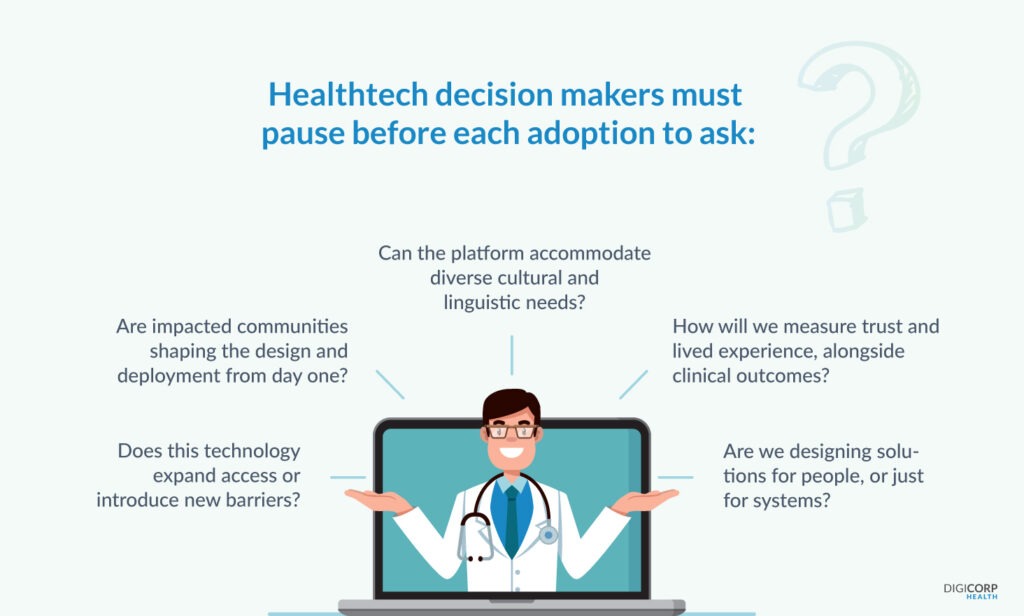
Good technology solves problems. Great technology understands people and reach people where they are.
The Road Ahead & An Opportunity In Waiting
The country has an opportunity to reshape care for people who have waited the longest. But this opportunity, without thoughtful leadership, will repeat old mistakes. When leaders see the patient not as a data point but as a full human shaped by family, culture, environment, and lived history, innovation becomes meaningful. That is how healthtech can build a future for marginalised communities where everyone feels seen, supported, and cared for.
If your goal is to close care gaps with technology that truly serves people, Digicorp can help. We work with healthcare teams to design solutions that respect culture, build trust, and strengthen access for every community.
Schedule A Call Now
Sanket Patel
- Posted on November 25, 2025
Table of Contents