Why Voice Technology is the New Infrastructure of U.S. Healthcare Systems
Table of Contents
In 2026, the conversation around voice technology in U.S. healthcare finally feels different. We’ve moved past the early phase where voice tools acted like “Siri in scrubs,” doing little more than turning spoken words into typed text. The stakes are much higher now. Voice is no longer a gadget or a convenience feature. It is steadily becoming the operating system that runs the clinical workflow end-to-end.
Before we go further, a quick clarification. When we talk about voice technology in 2026, we’re not referring to old-school dictation tools or consumer assistants like Siri and Alexa.
In U.S. healthcare, the term now widely used is Ambient Voice Technology or Ambient Clinical Intelligence. These systems “listen” during the natural flow of a clinical encounter, understand who is speaking, interpret medical context, and generate structured documentation and workflow actions in real time.
This distinction matters because the evolution of ambient voice is not about improving transcription. It represents a new layer of clinical infrastructure.
And for healthtech leaders, that shift is more pronounced. It isn’t about saving a few minutes on documentation anymore. It’s about rethinking how care is delivered, coordinated, and experienced across the entire system.
Beyond the Smart Microphone
For decades, a hospital’s idea of voice tech meant a quiet room, a physician dictating into a mic, and someone correcting the transcript later. It was helpful, but it did not change the structure of care.
Today’s ambient voice systems are a different world. They don’t wait for dictated speech. They listen, understand, and act in real time. They distinguish between speakers, recognize clinical context, and convert natural conversations into structured notes that drop directly into the EHR for review.
This isn’t just a pilot project anymore. Mass General Brigham recently expanded this technology to over 3,000 providers, reporting a 21% absolute drop in physician burnout as documentation burden fell.
And the value is spreading across teams like:
- Doctors dictate assessments and treatment plans that are turned into structured documentation and billing-ready codes in real time.
- Nurses use voice-controlled systems at the bedside to pull up lab trends, record vitals, and follow protocols without breaking sterile workflows or leaving the patient.
- Telehealth clinicians rely on speech recognition to document virtual visits automatically, maintaining continuity of care without adding after-hours charting.
Building a “Post-Keyboard” Hospital
The long-term vision for health systems is clear: a clinical environment where keyboards become the exception rather than the norm.
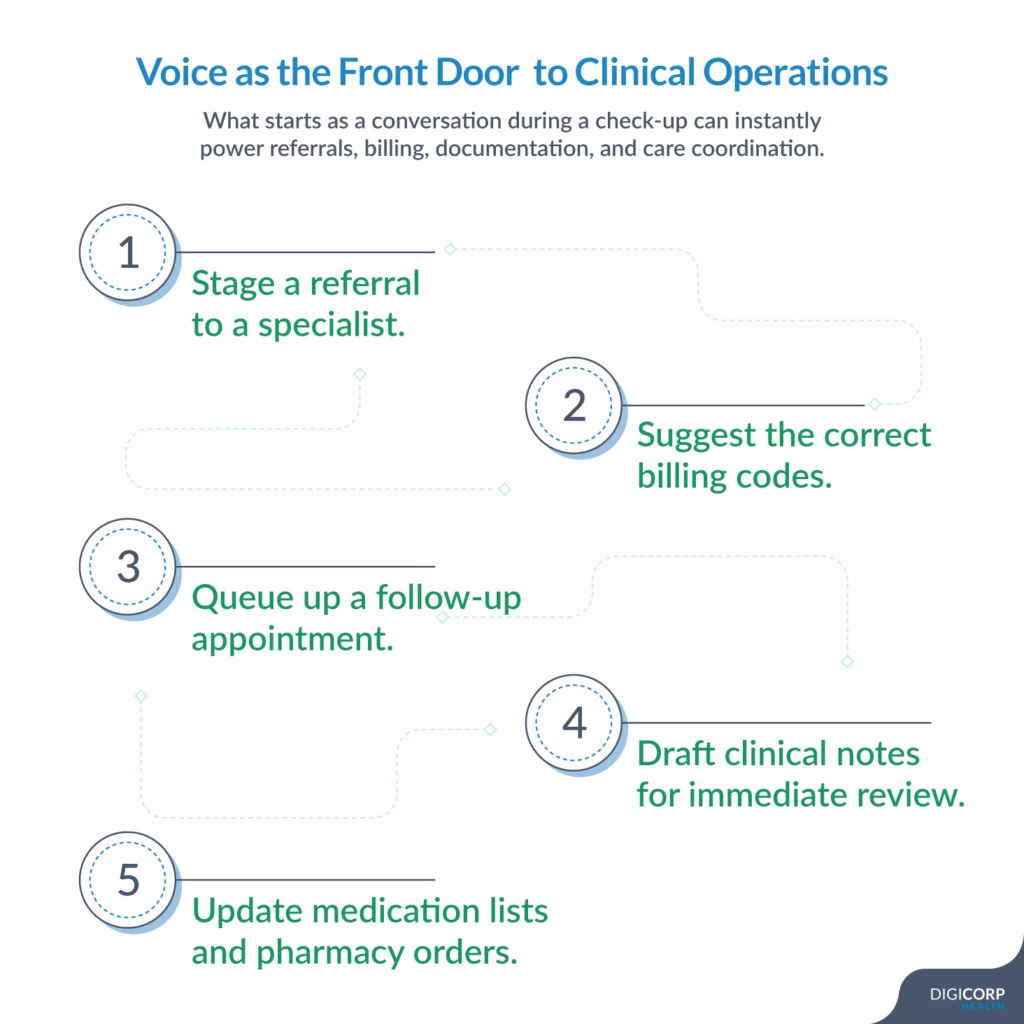
When voice becomes the primary way we capture data, it does more than just fill out a form. It becomes a trigger for the entire hospital. A spoken plan during a check-up can automatically:
- Stage a referral to a specialist.
- Suggest the correct billing codes.
- Queue up a follow-up appointment.
- Draft clinical notes for immediate review.
- Update medication lists and pharmacy orders.
This creates a massive “data advantage.” Systems that rely on ambient voice generate cleaner, more detailed records than those that rely on rushed, handwritten notes. For leaders managing value-based care contracts, this real-time, high-quality data is the new gold standard.
Operational teams are feeling this shift as well:
- Front-desk teams use voice to handle intake questions, appointment confirmations, and insurance verification, reducing call volumes and wait times.
- Internal teams trigger orders, consults, and task assignments using natural speech instead of navigating multiple screens and forms.
All of this creates a massive data advantage. Systems that rely on ambient voice generate cleaner, more granular records than those in a non-voice tech world. For leaders managing value-based care and quality metrics, real-time, high-fidelity data becomes the new gold standard for risk adjustment, outcome tracking, and AI model training
The “Voice Fabric” for Patients
The shift is not only happening inside the exam room. A “voice fabric” is emerging that follows a patient throughout the entire journey across a fragmented U.S. system.
Today, voice-powered conversational platforms and clinical voice assistants already support:
- Pre-visit symptom triage and appointment scheduling through automated phone lines and smart speakers.
- Medication reminders, recovery guidance, and check-ins through voice bots embedded in patient mobile apps and remote monitoring programs.
- Hands-free interactions at home for elderly or visually impaired patients, who can report symptoms or request help without navigating a portal.
Systems like Cedars-Sinai and Mayo Clinic are already using these agents to handle triage and post-discharge follow-ups. Instead of sitting in a queue or decoding a complex portal, a patient can simply “talk to their health system,” while the underlying voice layer handles routing, documentation, and escalation.
This same voice fabric is also transforming virtual and home-based care:
- Telehealth visits are transcribed and structured in real time, and lowering administrative overhead.
- Remote patient monitoring programs use voice to capture daily symptoms and adherence, feeding data back into care management dashboards without adding more apps to a patient’s life.
The New Strategic Mandate
If you are a health tech leader, then it’s high time to go over how you can integrate it as infrastructure within your current capabilities.
When health systems use voice to absorb administrative weight and simultaneously serve as connective tissue across the patient journey, they do something powerful: They turn “listening” into infrastructure.
This shift is not just about productivity or automation. It is about building a more human model of care, one where clinicians regain time, workflows finally make sense, and patients feel supported without navigating complexity.

Sanket Patel
- Posted on January 27, 2026
Table of Contents